I recently got into a debate with a colleague about modeling an industrial batch process. The argument was simple: "The Operator presses a button, the Machine runs, the Machine finishes, the Operator checks the quality. It’s one timeline. Why split them into two Pools?"
On paper, merging them into one Pool looks clean. Elegant, even. In the factory, this logic will break things. He is confusing Time with Control. Just because two things happen one after another doesn't mean they share a brain.
1. The "Toilet Test" (Independent States)
In BPMN, if you put the Operator and the PLC in the same pool, they share a Lifecycle. If the Token is busy doing Task: Mix Ingredients (PLC), then theoretically, the Operator ceases to exist.
In the real world: The PLC is a rock with electricity inside. It does not sleep. The Operator is a human. They get tired. They go for a smoke. If the Operator goes to the bathroom, does the PLC stop the agitator instantly? No. Two brains = Two Pools.
2. The "Lifecycle" Disconnect
The Operator's Process starts when the Order comes in and ends when the paperwork is signed. The PLC's Process starts when I flip the main breaker on the wall and ends only when the plant shuts down or explodes. If you merge them, you are saying the Operator must stay awake for 5 years until the machine is turned off.
3. The "Cabling" Reality
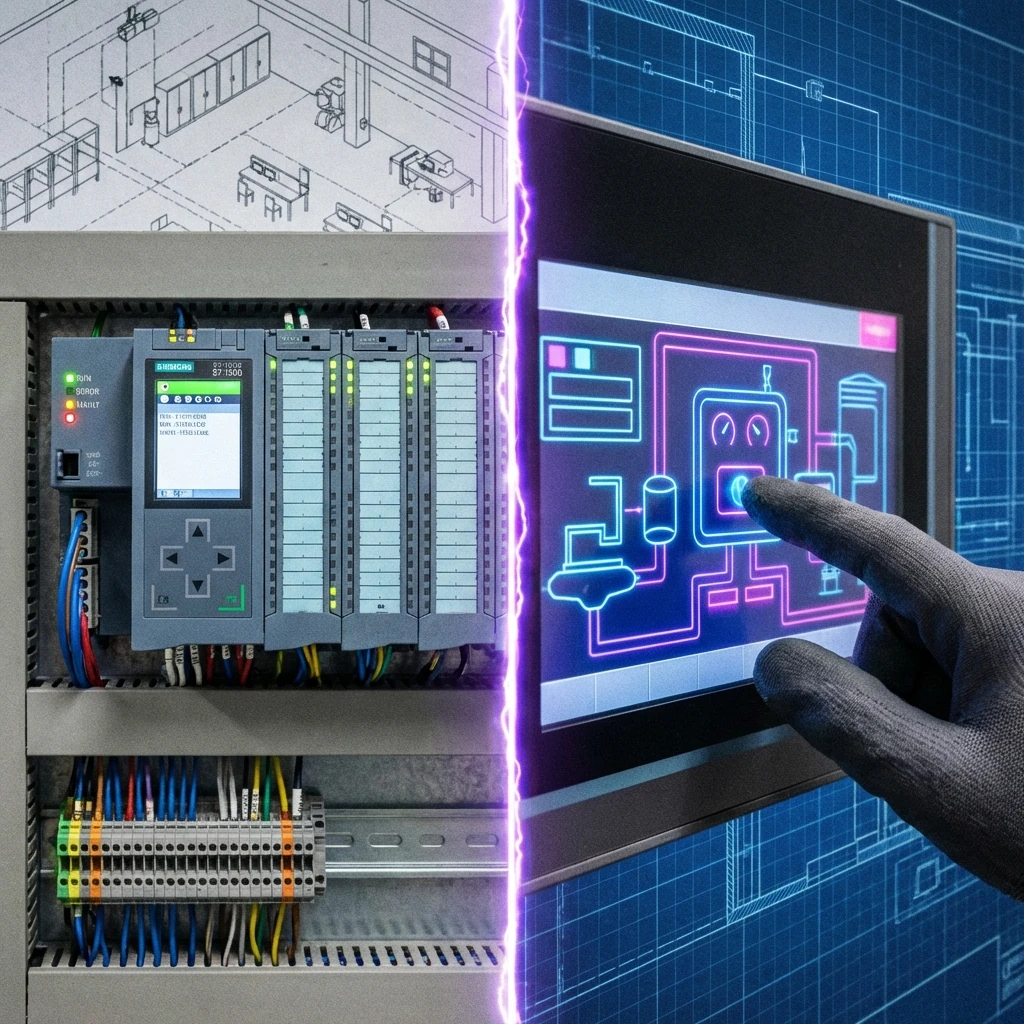
Your Operator Process runs on a server. Your PLC Process runs on a Siemens controller in a dusty cabinet. You cannot run a High-Speed Agitator logic inside a web browser. If you try to model it that way, the first time the Wi-Fi blinks, your tank overheats.
Split them up!
- Pool 1 (Operator): The high-level logic. The "Why" we are doing this.
- Pool 2 (PLC): The low-level logic. The "How" we survive this.
The "Dashed Line" is the Contract
The space between the pools is the Interface. When you use two pools, you must use Message Flows (dashed lines). This is the most important part of the architecture: the TCP/IP packet, the Modbus register, the physical button on the panel. If you hide this complexity, you are telling developers "magic happens here." In engineering, magic is just a bug we haven't found yet.